
这是一份可以照着还原任何一次测试的档案。我的局域网小主机 235h 上跑过好几个 26B 级模型,踩过的坑基本都在这里了。写下来是因为每次换模型、换后端都要重新查一遍,太浪费。
机器速查
| 项目 | 值 |
|---|---|
| 主机 | 235h — Windows 11 企业版 LTSC 26200 |
| IP | 192.168.31.61(SSH 免密) |
| CPU | Intel 14 核 14 线程,Max 2.0GHz |
| GPU | Intel Arc 140T 核显(12GB,UMA 共享) |
| 内存 | 23.5 GB |
| 核显共享显存 | 默认 57%(约 13.4GB)→ 调优后 87-90%(约 19.7-21.2 GiB) |
第一个坑默认 57% 共享显存装不下 16GB 的 26B 模型,Vulkan / SYCL≥24 / OpenVINO 全部报
OutOfDeviceMemory 或 res=-3。必须调注册表 SystemPartitionCommitLimitPercentage(详见 核显共享显存调优)才有一切。模型清单:两条路线
路线 A:OpenVINO IR(官方预转换)
| 属性 | 值 |
|---|---|
| 模型 | gemma-4-26b-a4b-it-int4-ov |
| 类型 | OpenVINO IR,INT4(NNCF INT4_ASYM gs128,AWQ 精度) |
| 大小 | 20 文件 / 14.3 GB |
| 下载源 | OpenVINO/gemma-4-26b-a4b-it-int4-ov(hf-mirror) |
IR 目录里的文件构成:openvino_language_model.bin 是主体(13.0 GB),openvino_vision_embeddings_model.bin 是视觉编码器(547 MB),还有 tokenizer、detokenizer、text_embeddings 各自的 bin/xml。多模态靠 VLMPipeline 处理,支持图片输入。
踩坑记录:openvino_language_model.xml正确大小应是 5.1 MB。局域网内曾流传一个被截断成 118 KB 的坏文件,加载直接报Error parsing element attribute at offset 118773,得从 hf-mirror 重下正确版。
路线 B:GGUF(llama.cpp 通用格式)
| 模型 | 大小 | 参数量 |
|---|---|---|
| gemma-4-26B-A4B-it-Q4_K_M.gguf | 16.02 GB | 26B.A4B |
| supergemma4-26b-uncensored-fast-v2-Q4_K_M.gguf | 16.02 GB | 25.23B |
下载源速查
| 源 | 说明 |
|---|---|
| hf-mirror(OpenVINO IR) | cdn 302 → us.aws.cdn.hf.co,实测 curl -L 约 26 MB/s |
| ggml-org(GGUF) | llama.cpp 官方原版转换 |
路线 A 实测:OpenVINO GenAI 原生管线
最关键的一条更正(2026-09-04):正确的后端是 ATTENTION_BACKEND=PA,不是 SDPA。SDPA 会导致长上下文 decode 严重衰减——8k 就掉到约 2 t/s;而 PA 全程平坦,约 14-15 t/s 一直撑到 16k。早期"必须用 SDPA 绕过连续批处理断言失败"的结论是错的。
import openvino_genai as ov_genai

MODEL_DIR = r"C:\path\ov-gemma4-26b"

# PA 后端:长上下文 decode 不掉速
# 32k 级长输入再加 KV_CACHE_PRECISION=u4
pipe = ov_genai.VLMPipeline(
    MODEL_DIR, "GPU", **{"ATTENTION_BACKEND": "PA"}
)

res = pipe.generate(
    "请用中文简述量子纠缠是什么,并给出一个应用例子。",
    max_new_tokens=120,
)
print(res.texts[0])
API 调用四个注意点
- 用命名参数(
max_new_tokens=),不要显式传 GenerationConfig 对象。 temperature=0.0不被接受(do_sample 时须大于 0),用默认温度。- 输出取
res.texts[0]。 - 必须用 VLMPipeline,用 LLMPipeline 会报找不到
input_ids(因为输入是inputs_embeds)。
GenerationConfig 采样默认值
| 字段 | 默认 | 说明 |
|---|---|---|
| do_sample | False | 默认 greedy(最快);True 走采样更慢 |
| temperature | 1.0 | 采样温度 |
| top_k / top_p | ∞ / 1.0 | 采样开关 |
四条路线的最优方案
| 用途 | 最佳路线 | 关键数字 |
|---|---|---|
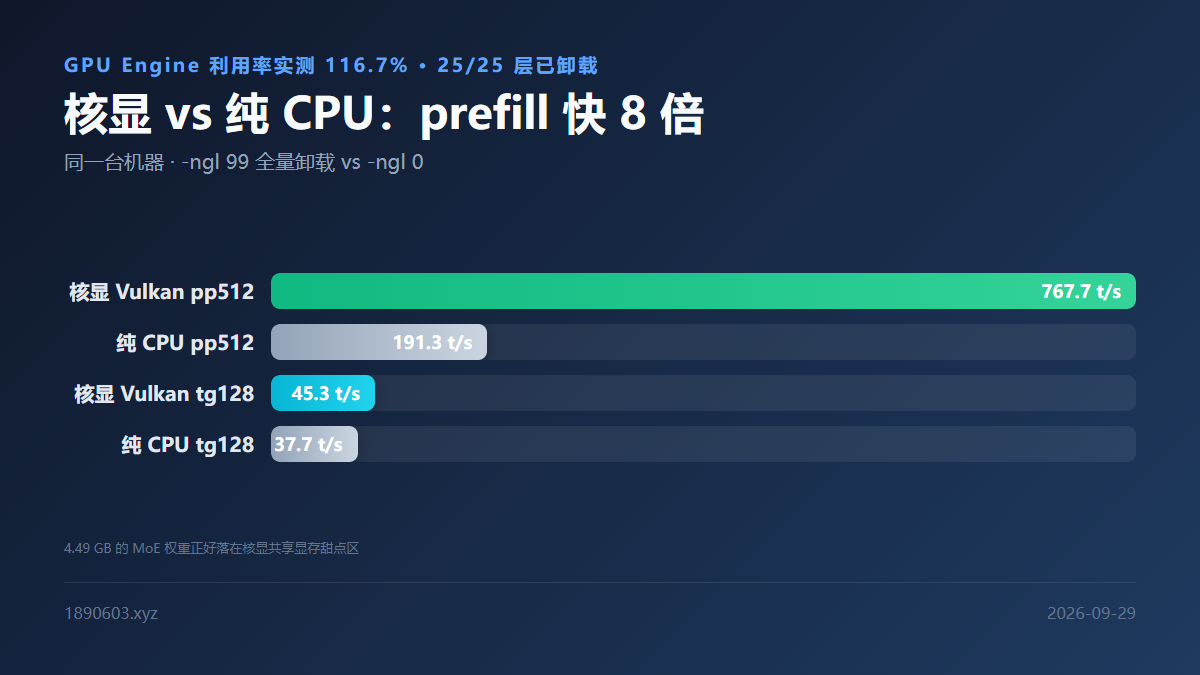
| 通用推理 | llama.cpp Vulkan 全量 offload | pp512 243.6 / tg128 21.4 t/s |
| 官方 IR 权重 | OpenVINO GenAI(PA 后端) | pp512 约 500 / decode 14-15 t/s |
| 长上下文常驻 | llama-server -ub 256 -c 65536 | 20K+ 稳定,prefill 69.3 t/s |
| 16K 基准测试 | serve_ov.py(OV PA 后端) | 16k+500 输出约 67s 往返 |
MoE 的一个重要限制26B.A4B 这种 MoE 模型,llama.cpp 是按层整层分配权重的,不能"激活的专家放 GPU、未激活的放 CPU"。所以虽然只有 4B 激活参数,16 GB 权重还是得整体装进显存——激活参数少不等于显存占用少。
服务化:长上下文参数怎么设
llama-server.exe -m <model>.gguf \
  -ngl 99 -t 8 -fa on \
  -ub 256 -c 65536 \
  --host 0.0.0.0 --port 8080 --cache-reuse 64
-c 65536+-ub 256在 ≤30k 范围内速度稳定,20k 时 prefill 69.3 t/s。--cache-reuse 64启用前缀缓存,重复前缀的请求能省掉大部分 prefill。- 更大的
-ub会吃 FA 临时内存,-c 65536+-ub 512我遇到过 iGPU 驱动级 OOM。
OpenVINO 后端的架构级 bug
gemma4 架构在 llama.cpp 的 OpenVINO 后端上,只有 stateless 模式能用,长上下文直接崩:E4B 崩在约 pos 1024,12B 崩在 1536/2048,26B 同样受影响。解法是 GGML_OPENVINO_STATEFUL_EXECUTION=0 配合 -fa 1。
所以如果你的模型是 gemma 系,走 OpenVINO 后端要留个心眼;Vulkan 后端虽然 prefill 慢一些,但长上下文稳得多。
复现路径速查
:: 测速(llama-bench)
cd C:\llama\vulkan
llama-bench.exe -m <gguf> -ngl 99 -t 8

:: 切到 OpenVINO 后端
set GGML_OPENVINO_DEVICE=GPU
cd C:\llama\openvino
llama-bench.exe -m <gguf> -ngl 99 -t 8
更细的测试脚本(prefill 扫描、decode 计时、内存监控、OV 性能提示)都归档在同一个目录里,共 40 多个脚本。日常最常用的三个:ov_prefill.py(prefill 扫描)、decode_timer.py(纯 decode 计时)、monitor_mem.py(共享内存占用监控)。
数据说明本文所有数字均为本机实测(235h / Arc 140T / llama.cpp b10621 / OpenVINO GenAI 2026.5 nightly),不同驱动与配置会有浮动。后端横评的详细数据见 llama.cpp 四后端横评,服务端化细节见 llama-server 服务化。