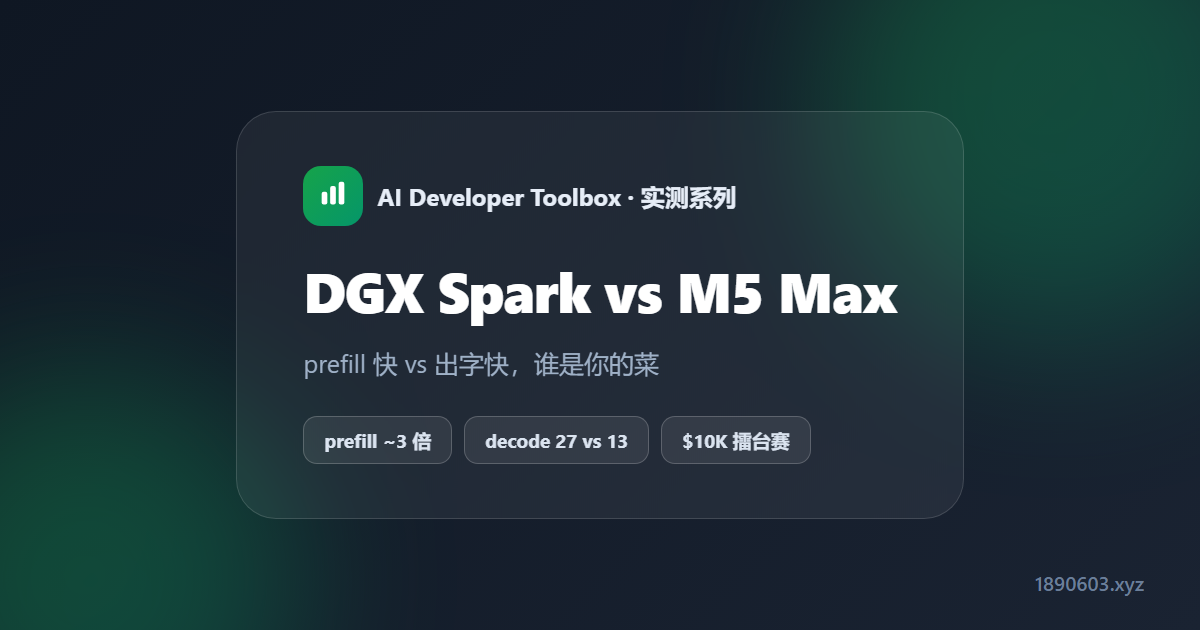
DGX Spark 与 Mac Studio M5 Max 对决:prefill 快 vs 出字快

预算 3.5-4.5 万、都要 128GB 统一内存、都能本地跑几百亿参数模型——NVIDIA DGX Spark(GB10,约 3.5 万)和 Apple Mac Studio M5 Max(约 4.2-4.5 万)常被放在一起比。但它们是两种完全不同性格的机器:一个「脑子转得快但说话结巴」,一个「说话最顺但干活偏科」。这篇用第三方评测数据拆清楚各自赢在哪儿。

硬件规格解释了很多问题,但运行时决定了剩余的部分。

核心差异:prefill(理解)vs decode(出字)

一次 LLM 调用分两段:prefill 把整个提示词一次读完(吃算力、出吞吐),decode 逐个蹦 token(吃带宽、出速度)。DGX Spark 有 1 PFLOP FP4 算力、带宽却只有 273 GB/s;M5 Max 带宽 614 GB/s 是它的 2.25 倍。结果天然分化:

prefill 提示吞吐 (tps, 越高越好)
DGX Spark~1200
Mac M5 Max~400
Qwen3.5-27B 输出速度 (tps)
Mac M5 Max~27
DGX Spark~13

prefill 侧 DGX 差不多是 Mac 的 3 倍(约 1200 vs 400 tps),特别适合长文档分析、RAG、工具调用这类「把一大段问题喂进去」的场景;而 decode 侧 Mac 几乎翻倍,适合「一口气读完长内容」。要反复问让 AI 干活 → DGX;要长时间读 AI 输出 → Mac。

微调与批处理:DGX 完胜(但普通用户用不上)

任务DGX SparkMac M5 Max
LoRA Llama4 8B~3.5h~14h (慢 4 倍)
QLoRA Qwen3 32B~12h~52h (慢 4.3 倍)
Full 70B 全量微调多天可行不可行
embedding 批处理几小时数天

原因:DGX Spark 跑的是完整 CUDA 生态(vLLM、微调框架齐全),Mac 只有 MLX/Metal,批处理没有 CUDA 的优化栈。但如果你只是个人对话助手或日常推理,微调/批处理的优势基本用不上——这更贴近专业研发场景。

功耗与电费:Mac 便宜太多

指标DGX SparkMac M5 Max
空载功耗~120W~25W
70B 推理功耗600-800W150-200W
每百万 token 电费$0.60$0.25

24 小时开机跑推理的话,Mac 的电费成本不到 DGX 的一半;静音与发热也是 Mac 的强项。DGX 满负荷约 240W、体积还小,但热量不低。长跑选手选 Mac,电费差距一年下来不小。

一台 M5 Max vs 两台 DGX Spark($10K 擂台赛)

至顶网做过一场有趣的擂台:一台 M5 Max 128GB(7999 美元)对阵两台 DGX Spark(9398 美元),跑 DeepSeek-V4-Flash(284B MoE),完成 Terminal-Bench 2.1 的 89 项任务。

指标M5 Max (1 台)双 DGX Spark
任务完成率47 项 / 54%45 项 / 52.3%
单路生成速度-54-58 tok/s
8 路并发-253 tps (每路 31.6)
服务上下文100K200K (2 倍)

完成率几乎打平,但双 Spark 的生成速度、8 路并发、上下文容量全面占优。只给一个人用 → M5 Max;多个 Agent 持续运行/团队共享 → 双 DGX Spark。

还有个「邪修」玩法:PD 分离

36氪实测 DGX Spark 单机批次=1 时解码仅 20 tok/s,批次=32 才升到 370。有人把它和一台 Mac Studio M3 Ultra(819 GB/s)组成流水线:DGX 负责 prefill、Mac 负责 decode,整体推理提速 2.8 倍——当然费用也翻 3 倍接近 10 万,属于发烧玩法,普通用户看看就好。

到底选谁

  • AI 研发/微调/批处理、离不开 CUDA、要 prefill 速度 → DGX Spark(能扩展,但只支持 Linux、功耗高)
  • 个人对话助手/创意工作、追求输出丝滑、要 macOS 生态 → Mac Studio M5 Max(带宽最高、静音省电,但贵且微调弱)
  • 都不确定 → 两个都是「专业向」机器;只偶尔玩玩,先看独显整机或等内存价格回落更实在。
个人对话助手买 Mac,开发者/批处理/微调买 DGX。两个都是好机器,只是为不同的人生的。
相关阅读:三台一起比(含 AMD 395)看128G AI 工作站横评;带宽为什么是命根子,看统一内存的带宽真相

数据说明:本文速度/微调/功耗数据来自 AI Bytes、Presenc AI、至顶网、36氪、知乎等第三方评测(2026 实测汇总),不同环境有差异,仅供参考。

At ¥35-45k with 128GB unified memory and the ability to run 100B-scale LLMs locally, the NVIDIA DGX Spark (GB10, ~¥35k) and Apple Mac Studio M5 Max (~¥42-45k) are natural rivals. Yet they have completely different personalities: one 'thinks fast but talks with a stutter', the other 'talks smoothest but is lopsided at work'. This post uses third-party benchmarks to show exactly where each wins.

Hardware specs explain a lot, but the runtime decides the rest.

The core difference: prefill (understand) vs decode (output)

An LLM call has two phases: prefill reads the whole prompt at once (compute-bound, throughput), and decode emits tokens one by one (bandwidth-bound, latency). DGX Spark packs 1 PFLOP FP4 but just 273 GB/s; the M5 Max's 614 GB/s is 2.25× higher. The result splits naturally:

Prefill throughput (tps, higher better)
DGX Spark~1200
Mac M5 Max~400
Qwen3.5-27B decode (tps)
Mac M5 Max~27
DGX Spark~13

On prefill, DGX is ~3× the Mac (~1200 vs 400 tps), great for long-doc analysis, RAG and tool-calling where you feed big prompts in; on decode the Mac nearly doubles it, great for reading long outputs. Repeatedly ask the AI to work → DGX; read long AI output → Mac.

Finetuning & batch: DGX wins big (but most users won't need it)

TaskDGX SparkMac M5 Max
LoRA Llama4 8B~3.5h~14h (4× slower)
QLoRA Qwen3 32B~12h~52h (4.3× slower)
Full 70B finetunefeasible in daysnot feasible
embedding batch jobshoursdays

Reason: DGX Spark runs the full CUDA stack (vLLM, complete finetuning tooling) while the Mac only has MLX/Metal with no CUDA-optimized batch pipeline. But if you're building a personal assistant or doing day-to-day inference, the finetuning/batch edge rarely matters — it serves professional research.

Power & electricity: the Mac is far cheaper

MetricDGX SparkMac M5 Max
Idle power~120W~25W
70B inference600-800W150-200W
Electricity per 1M tokens$0.60$0.25

Run inference 24/7 and the Mac's power bill is under half of DGX's; it also wins on noise and heat. DGX draws ~240W at full load despite the tiny box. For marathon runners, the Mac — the electricity gap adds up over a year.

One M5 Max vs two DGX Sparks (the $10K showdown)

ZDNet staged an interesting matchup: one M5 Max 128GB ($7,999) vs two DGX Sparks ($9,398), running DeepSeek-V4-Flash (284B MoE) across Terminal-Bench 2.1's 89 tasks.

MetricM5 Max (1 unit)Dual DGX Spark
Tasks completed47 / 54%45 / 52.3%
Single-stream decode-54-58 tok/s
8-way concurrency-253 tps (31.6 each)
Served context100K200K (2×)

Task completion was nearly tied, but the dual Sparks win on decode speed, 8-way concurrency and context length. One person → M5 Max; many agents or a shared team → dual DGX Spark.

A 'spicy' hack: PD separation

36Kr measured DGX Spark at just 20 tok/s decode at batch=1 (370 at batch=32). Someone pipelined it with a Mac Studio M3 Ultra (819 GB/s): DGX does prefill, the Mac does decode, speeding up total inference 2.8× — at triple the cost (~¥100k). A tinkerer's flex, most users can just watch.

So which one?

  • AI research/finetuning/batch, need CUDA, want prefill speed → DGX Spark (expandable, but Linux-only, power hungry)
  • Personal assistant/creative work, want smooth output, live in macOS → Mac Studio M5 Max (top bandwidth, quiet and efficient, but pricey with weak tuning)
  • Not sure → both are pro-oriented; for occasional tinkering, a discrete-GPU build or waiting for DRAM prices to fall is more sensible.
Buy the Mac for a personal assistant; buy the DGX for developing, batching and finetuning. Both are great machines — just built for different people.
Related:For all three together (incl. AMD 395) see the 128GB AI workstation roundup; why bandwidth is everything, see the unified-memory bandwidth truth.

Data notes: speed/finetune/power figures from third-party reviews (AI Bytes, Presenc AI, ZDNet, 36Kr, Zhihu, 2026), vary by environment, for reference only.

返回文章列表